Assya Agbere, Absalon, Heidi Bucher, Marinette Cueco, Lou Fauroux, Dominique Gonzalez-Foerster, Donna Gottschalk, Konstantinos Kyriakopoulos, Laura Lamiel, Seulgi Lee, Lori, Ash Love, Nathalie Magnan, Beatriz Santiago Muñoz, Nam June Paik, Rosemarie Trockel, Madame Zo.
When Virginia Woolf examined the factors that had prevented women from accessing literary production, she asserted as early as 1928 the necessity of a room of one’s own and financial independence in order for creation to take place. In the mid-1990s, as Guillaume Dustan invited readers into his bedroom, recounting his sexuality as a cultural and political practice, a generation of teenagers — the generation of Bedroom Culture, those who connect to the world from their bedrooms via the Internet — began a form of self-education through images, using (online) video games, proto-social networks, video channels and other platforms for exchange. The bedroom and its connected screen thus became porous to virtuality, multiplying points of access to digital worlds.
With the arrival of media — television, the telephone, the Internet, the laptop, the smartphone — the bedroom is no longer simply a private space devoted to sleep and dreaming; it becomes a site of communication, production and consumption. Technologies ultimately dissolve the boundaries between private and public spheres, between real and virtual life. We browse, read, write, work, chat, shop, email, stream, Zoom, feel, play online, exist in cyberspace — from our beds. We are there and not there at the same time, wherever we are, wherever we go. We expand the experience of virtuality: the experience of what does not exist materially, yet remains active, what has an effect on reality, on the physical world, through a technical, mental or psychic support. Are cyberspace and dreams not populated by digital creatures, variable existences, ghosts with whom we act, converse, work, love, govern?
From A Room of One’s Own to Bedroom Culture, passing through dreams and cyberspace, this group show explores our relationship to virtuality, where a network of subjectivities and desires is woven, and brings together works and artists who move fluidly between these different worlds.
Frac Nouvelle-Aquitaine MÉCA
MÉCA
5, Parvis Corto Maltese
33 000 Bordeaux
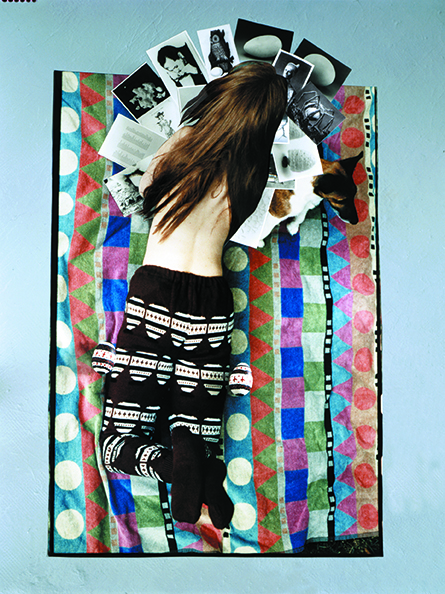
Rosemarie TROCKEL, “Leben heiBt Strumpfhosen stricken” (Vivre cela veut dire tricoter des collants), 1998, © Adagp, Paris, 2026. Collection Frac Nouvelle-Aquitaine MÉCA. Crédit photographique : Frédéric Delpech